DIAGNOdent
Naperville, IL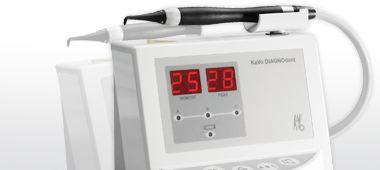
For decades, the standard tools for finding tooth decay were a dental mirror, a sharp explorer, and a set of X-rays. These methods have served dentistry well, but they share a common limitation: they tend to catch cavities only after they are visible or large enough to show up on film. By then, decay has often progressed well into the tooth, sometimes requiring a dental filling, dental crown, or even a root canal. DIAGNOdent dental technology was developed to close that gap, giving dentists, including Wheaton Oral Surgery, a way to detect decay at its earliest, most treatable stage.
What Is DIAGNOdent?
DIAGNOdent is a laser fluorescence device used to detect cavities, particularly in the deep grooves and pits of the chewing surfaces of teeth, where traditional visual exams and X-rays often struggle to reveal early decay. The device uses a small, pen-like probe that emits a harmless, low-intensity laser light onto the tooth surface. Healthy enamel and dentin reflect this light in a predictable, minimal way. Decayed tooth structure, however, has a different molecular composition due to bacterial byproducts and mineral loss, which causes it to fluoresce and reflect light differently than healthy tissue.
The DIAGNOdent unit measures this fluorescence and converts it into a numerical reading on a small screen, along with an audible tone that rises in pitch as the reading increases. A low number generally indicates healthy tooth structure, while higher numbers suggest increasing demineralization or decay. This gives the dentist an objective measurement to work with, rather than relying solely on visual judgment or a metal explorer, which can sometimes create tiny defects in a tooth's surface or miss decay hidden below an intact layer of enamel.
Why Early Detection Matters
Tooth decay does not appear overnight. It develops gradually as bacteria in the mouth metabolize sugars and produce acids that slowly dissolve the mineral content of enamel and dentin. In its earliest stages, this process can sometimes be halted or even reversed through improved oral hygiene, dietary changes, and fluoride treatment, without any drilling or restorative work at all. Once decay progresses past this early stage and creates an actual cavity, though, the tooth structure cannot regenerate on its own, and a filling or more extensive treatment becomes necessary.
The challenge for dentists has always been that the chewing surfaces of molars and premolars contain deep, narrow grooves called fissures. These trap bacteria and food particles while remaining nearly impossible to fully evaluate with an explorer or standard visual exam, since decay can hide beneath a thin, intact layer of enamel. Traditional X-rays are also limited here, since they tend to be more effective at detecting decay between teeth or below the gumline than within fissures. DIAGNOdent gives dentists a non-invasive way to evaluate these hard-to-see areas with far greater sensitivity, often catching decay months or years before it would otherwise be found.
What to Expect During a DIAGNOdent Exam
Patients typically will not notice much difference in their routine visit when DIAGNOdent is used. After a standard cleaning and exam, the dentist or hygienist may use the small laser probe to scan the chewing surfaces of the back teeth, particularly molars and premolars, which are most prone to fissure decay. The process is quick, painless, and involves no radiation, unlike X-rays. Each tooth is typically scanned in just a few seconds, with the device providing a numerical reading for each site examined.
If a reading suggests a low likelihood of decay, no treatment is needed beyond continued monitoring at future visits. A moderate reading might prompt a more conservative approach, such as a preventive sealant, more frequent fluoride application, or closer monitoring to see if the reading changes over time. Only a reading indicating significant decay would typically call for a filling. This tiered approach allows for far more conservative, individualized treatment planning than a simple "cavity or no cavity" determination.
The Benefits of Laser Cavity Detection
One of the most significant advantages of DIAGNOdent is how it supports minimally invasive dentistry. Because the device can identify decay at such an early stage, patients often have the chance to address a developing problem through prevention rather than restoration, sometimes avoiding a filling altogether. Since every filling represents a permanent alteration that will eventually need to be replaced or repaired, reducing unnecessary restorations has real long-term value for a patient's oral health.
DIAGNOdent also adds a layer of objectivity to diagnosis. Rather than relying entirely on visual interpretation, which even experienced clinicians can find difficult in certain lighting or with certain tooth anatomy, the device provides a consistent, repeatable measurement. This is especially useful for tracking a suspicious area over time: a borderline tooth can be rescanned at a future appointment, and the dentist can compare readings to see whether the area is stable, improving, or worsening.
Because the exam involves no radiation and no drilling, it is also a comfortable, low-stress addition to a routine visit, which anxious patients often appreciate.
Who Can Benefit Most?
While DIAGNOdent can be useful for any patient, it offers the greatest value for those at higher risk of decay, including children and teenagers whose molars have deep, newly erupted fissures, patients with a history of frequent cavities, and those who struggle to maintain hygiene due to braces or dry mouth. It is also valuable for monitoring teeth with suspicious areas that do not yet clearly warrant a filling.
A Tool, Not a Replacement
It is worth noting that DIAGNOdent is not intended to replace X-rays, visual exams, or a dentist's clinical judgment. Rather, it works alongside these traditional methods, adding another layer of information that helps guide more precise, conservative decision-making. A comprehensive exam still includes a visual inspection, appropriate X-rays, and a discussion of a patient's individual risk factors and history.
By catching decay earlier and with greater precision, DIAGNOdent reflects a broader shift in modern dentistry toward prevention and conservation of natural tooth structure. For patients, this means fewer surprises at the dentist's office, more opportunities to reverse early decay through simple lifestyle changes, and greater confidence that a treatment plan is based on objective, measurable data rather than guesswork alone.
|


